Ten Square Feet of Truth: Inside the Fitting Room's Silent Negotiations
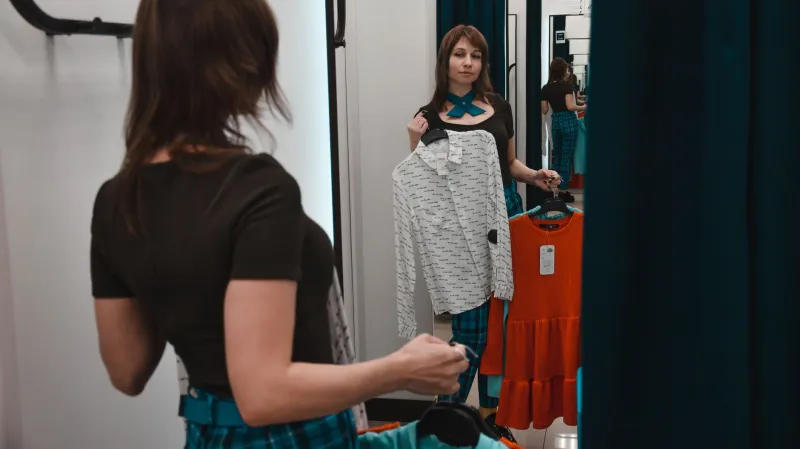
There's a moment—universal, unphotographed, deeply unglamorous—when you catch your reflection in a fitting room mirror under lighting that flatters absolutely no one. The jeans are half on. Your phone is balanced on a hook designed for neither phones nor hooks. And somewhere between the zipper and the verdict, you start talking. Out loud. To yourself.
We don't talk about this enough. The fitting room is where the fantasy of shopping collides with the reality of our bodies, our budgets, and our baggage. It's a confessional with fluorescent lighting, and everyone leaves having admitted something.
The Things We Say to Ourselves
Ask around and the private monologues start pouring out. A friend in Chicago admits she regularly narrates her fitting room sessions like a sports commentator: "She's going for the size up. A bold move. The crowd holds its breath." Another confesses to staging full arguments with an imaginary stylist, defending a sequin blazer she has no occasion for. "I said, he's going to wear it, and the stylist said, to what, Kayla? To what?"
Then there's the grief. Few spaces force a reckoning with a changing body quite like a 10x10 box with three-way mirrors. A woman I'll call D., 42, told me she keeps a running tally of what she calls "the mourning sizes"—the pieces she tries on anyway, knowing. "It's not vanity. It's like visiting an old house you used to live in. You just want to see if it still fits you, even once."
Consumer psychologists have a term-adjacent explanation: the fitting room is where anticipated identity meets current reality. You're not trying on a blazer. You're trying on the version of yourself that wears it—to the promotion, the wedding, the version of your life where you're the kind of person who owns a linen jumpsuit.
The People Who See Everything
Fitting room attendants may be the most underrated sociologists in America. Marisol, who's worked the floor at a department store outside Dallas for eleven years, has heard it all. "People talk to the mirror like it's their therapist. They apologize to the clothes. One lady said 'I'm sorry' to a dress like it owed her money instead."
The attendants develop pattern recognition. The size tag that gets tucked in, hidden, then quietly re-hidden. The item held up against the body in the hallway mirror—the official dodge of commitment. The "I'll think about it" that everyone, staff and shopper alike, knows means goodbye forever.
And the impulse decisions? Marisol says the tell is silence. "When someone's been chatty and then goes quiet, they've decided. Quiet means sold."
Why the Lighting Is Never on Your Side
Part of the fitting room's power is its hostility. At home, your mirror knows you. The lighting is your ally. In the fitting room, you're meeting yourself under interrogation lamps, in a space that smells like other people's cologne, holding a garment that cost more than your electric bill.
Retail designers know this, of course. Some stores engineer warmer light, wider mirrors, flattering angles—an empathy architecture. Others, whether by accident or design, keep the harsh stuff. Either way, the negotiation happens: is this how I look, or is this how this room looks? Learning to tell the difference might be the most useful style skill nobody teaches.
The Verdict
Here's what the fitting room ultimately confesses: we don't shop for clothes. We shop for proximity to who we want to be. Sometimes the mirror agrees and the bag goes home with us. Sometimes it doesn't, and we fold everything neatly—the good manners of the disappointed—and walk out into the mall light, already thinking about the next box, the next curtain, the next quiet conversation with ourselves.
Honest venue, indeed. No filter required.